Welcome
If you long to live more in alignment with who you truly are, you are most welcome here. You can come just as you are, right where you are. There is nothing you need to fix before working with me. No mask to wear. No pretense. No story to polish. No version of yourself you need to become first. Every meaningful transformation begins with a simple recognition: I am right here.Biloxi stands for intentional transformation. It is not about maximizing your potential, upgrading your life, or becoming more efficient at being yourself. It is not about optimizing your performance or turning your life into something to be perfected. It is not about becoming someone else. Intentional transformation is existential. It's about becoming more fully yourself. And as that happens, the way you relate to your life, and to life itself, begins to transform. Conflict loosens its grip. Intimacy feels safer. Uncertainty becomes something you can stay present with. And over time, you become more and more who you truly are.This work is for those who are willing to experience more fully what is happening within them, whether life feels steady or shaky. This work requires honesty. It requires a willingness to feel. It requires courage to explore what lives inside of you.If something in these words resonates, you are welcome to explore what I offer, learn more about how I work, or reach out to me when you feel ready.

Who I am
I don’t know who I am. This is the most honest place for me to begin. I believe who we are cannot truly be captured in words. Any attempt to do so will always be incomplete. What I can share is how certain qualities were already present in me from an early age, and how life has walked through me.From the moment I could talk I questioned life. Not to be difficult (though I have often been perceived that way), but out of curiosity and a deep need to understand the world I was living in. At a very young age I noticed that many people around me saw truths as absolutes, while I was not that certain. I experienced truth as relative, dependent on perspective and context. In my worldview, it all depends on how you look at it.Being a sensitive child I also noticed that words on their own are not very reliable. I listened to tone, noticed the spark in the eyes (or the lack of it), and felt the energy someone radiates. Through this, more truth was revealed to me than words could convey.I also had deep thoughts. When I was around four years old I spent months contemplating a question that both fascinated and frightened me: is nothing something? After looking deeply into it I reached a conclusion that felt comforting to me: nothing does exist, and everything arises from it.As I grew older, I felt drawn to natural philosophers such as Heraclitus, who spoke of how everything flows. His words gave language to something I already sensed. I also felt drawn to Eastern philosophies, especially Taoism and Zen Buddhism.A turning point came in 2006, when I was 29 years old. During a few days in a silent monastery, where I only had a bed, a desk, a chair and a Bible, something became painfully clear: my need to understand life was also a way of trying to control it. In the stillness I saw a truth I had not wanted to face. I tried to avoid uncertainty. Underneath my confidence I was insecure and afraid, which was the opposite of how I saw myself and how I presented myself to the world.In the monastery I realized that life does not bend to control. It invites trust, surrender, and faith. A line from Proverbs stayed with me: “Trust in the Lord with all your heart and lean not on your own understanding.” I took it as an invitation into surrender, not as an idea, but as a lived practice. Right there and then I understood what “the truth will set you free” really means. I broke through a wall of insecurity, a wall I had believed protected me from misery. Instead of misery I found a beautiful landscape ready to be explored. I opened myself up to the unknown, to adventure, to life. I started living. When I returned home I left my job and began working for myself. Biloxi was born, and I was reborn.Twenty years have passed since then. I’m 49 years old now. Together with my wife and our 4 children we live in the countryside of eastern Norway. And it's also where I work.Sebastian

What I offer
I work with people who are drawn to intentional transformation. The form can differ, yet the essence is the same: presence, honesty, and a quiet space where what is unfelt can be felt, and what is unconscious can become conscious. All the work I offer is embodied. Even when we speak, we do not stay in concepts. We pay attention to what happens in your body. Tension. Contraction. Warmth. Numbness. What has been repressed often remains stored in the body. When it is met with gentle care and without judgment, the body softens and regulation returns to the nervous system. Healing tends to happen through feeling, not through thinking. You can enter this work through different doorways:
1. One-on-one coaching (online or at our place)
A quiet, grounding space where you can slow down, feel what is happening inside of you, and bring awareness to the unconscious patterns, beliefs, and emotions shaping your life.
→ Click here for more information2. IoPT group session (only online)
A group based process for exploring inner conflict, patterns, and trauma based dynamics through the intention method and resonance.
→ Click here for more information3. Tantra massage (at our place)
A respectful form of touch that helps you feel, soften, and reconnect with your body. The body remembers what the mind has forgotten. Through presence and breath, blocked energy begins to move again, allowing release, openness, and renewed vitality.
→ Click here for more information

1. One-on-one coaching
One-on-one coaching with me is a quiet, grounding space where you can slow down, feel what is happening inside you, and bring gentle awareness to the unconscious patterns, beliefs, and emotions shaping your life.Together, we explore your inner landscape with presence and curiosity. Not to fix you (you are not broken!) but to help you see what has long been unseen, feel what has long been unfelt, and reconnect with the truth of who you truly are beneath all the layers of conditioning.Sessions can help you with:
• Internal conflict
• Emotional clarity
• Relationship dynamics
• Boundaries
• Anxiety
• Life transitions
• Returning to yourselfA session lasts 75 minutes. Sessions can be booked weekly, bi-weekly, or as needed. For prices see the pricelist.

2. IoPT group session
IoPT stands for Identity Oriented Psychotrauma Therapy. It is a simple and surprisingly precise way to explore inner conflict, attachment patterns, and trauma based dynamics. You do not need to tell your whole story. You work with an intention, and the process reveals what is usually unconscious.You start with one clear sentence, an intention, such as “I want to feel safe in intimacy” or “I want to understand why I keep repeating this pattern.” In the group, words from the intention are represented through resonance. What becomes visible is often not intellectual. It is experiential. It shows how different parts of you relate to each other, where there is tension, and what wants to be acknowledged.IoPT can be helpful when you:
• feel stuck in repeating patterns, even though you understand them
• notice inner conflict, self doubt, or self sabotage
• struggle with boundaries, intimacy, or relationships
• carry shame, guilt, fear, or a persistent inner tension
• sense that something from the past is still active in the present
• want to meet what is held in the body, not only talk about itThe sessions are facilitated by my wife Gina. I will be present and participating in the group.A group session lasts approx. 4 hours. You can choose if you only observe or participate. We usually plan 3 groups ahead, about every 4 weeks. For prices see the pricelist.

3. Tantra Massage
Tantra massage is a healing, body based practice that supports embodiment, nervous system regulation, and a deeper connection with yourself. It meets both body and energy. Through presence, touch, breath, and pacing, what has been held in the system can begin to move.In the language of energy work, we can carry blockages in the body, in the breath, and in the emotional field. These blockages are often protective patterns that once helped you cope. When the body feels safe enough, they can soften. As they do, life energy can start to flow more freely again. Many people experience this as more aliveness, more sensitivity, more openness, and a deeper sense of being at home in themselves. It can also feel rejuvenating, as if something in you comes back to life.The body knows. The body remembers. Old emotions, tension, and unmet experiences can live in the nervous system long after the original events have passed. This work supports the system in releasing what it no longer needs to hold.Healing can show itself in different ways. For example:
• emotions rising and moving through
• spontaneous shaking, trembling, warmth, tingling, or deep sighs
• burping or other natural signs of nervous system release
• memories, images, or insights surfacing, sometimes from places that felt long forgottenWhatever arises is met with care. We go slowly, and we stay within what feels manageable for you. You remain in control throughout.I work only with women. Yoni massage is optional. It is never assumed and never expected. It is only included if you explicitly want it, and only if it feels right in the moment. Consent is continuous, and we communicate throughout the session.A tantra massage session lasts approx. 3 hours. It's mandatory to take a shower before the session. Afterwards it's possible to remove oil if you want to. Sessions can be booked weekly, bi-weekly, or as needed. For prices see the pricelist.

Pricelist
The prices below apply for 2026. All amounts are stated in Norwegian kroner (NOK) and include 25% VAT. Approximate equivalents in euros (EUR), US dollars (USD) and Japanese yen (JPY) are provided for reference, based on the previous day’s exchange rate.
Cancellation policy
Sessions can be cancelled or rescheduled free of charge up to 24 hours before. If you cancel within 24 hours, or do not show up for your appointment, the full session fee will be charged. This policy exists to protect the time that has been reserved for you. If there are unforeseen circumstances please reach out. Life happens, and communication is always appreciated.

Where I work
At the end of a 2 kilometre private road, the landscape opens.On one side, a panoramic view over Lake Mjøsa, Norway’s largest lake. On the other side, forest. Dense, quiet woods with direct access to trails that begin right at our doorstep. No direct neighbours, except wildlife. Often we see deer, moose, squirrels and foxes. In winter, when snow covers the land for months, it is possible to step outside and go straight into cross-country ski tracks.Gjerdingen is even mentioned in the local trail network. It is not just a place to live, but a place to move, to breathe, to be in nature.We chose this property deliberately. To live closer to the elements. To experience the rhythm of the seasons more directly. The climate here is typical inland Norwegian: cold, stable winters and warm summers. Snow usually stays for around five months, from mid-November until mid-April. The silence of winter is profound. The light in summer stretches long into the evening.We are currently building a geothermal greenhouse, designed to be used year-round. A place where food can grow even when the ground outside is frozen. It reflects our intention to live more sustainably and more in tune with natural cycles.And yet, we are not isolated. Lillehammer, Hamar, and Gjøvik are all within a 30-minute drive. Culture, cafés, events and city life are accessible when desired. Nature and stillness when needed.Gjerdingen Gård is where we retreat. It is our home. It's quiet and peaceful up here, a place where silence still speaks.You are most welcome. The address is:Gjerdingen Gård
Solsvevegen 179
2390 Moelv, Norway


How I work
My work is simple. I offer a calm, non-judging presence where you can slow down, sense what is true within you, and reconnect with yourself in clarity. I don’t offer quick fixes, predefined steps, or scripted tools. I do not give answers and I do not tell you who to be. Instead, I meet you exactly where you are. I function as a mirror and support you in you in remembering what you already know, and who you have always been.Our work together begins with slowing down and becoming honest about what is happening in you. We explore what feels alive, what feels stuck, and what life seems to be asking of you right now. I listen closely. Not only to your words, but also to the deeper layers beneath them: the emotions, patterns, beliefs, and unspoken longings that shape your experience.Transformation, as I see it, unfolds naturally when we bring awareness to these deeper layers. It is less about “fixing” and more about seeing clearly, and from that clarity, discovering new ways of relating to yourself, others, and life.To guide this exploration, I often work with a framework I developed over many years: The Cycle of Change. It describes four natural states we move through when life invites us to grow — Comfort, Crisis, Courage, and Competence. Understanding where you are in this cycle helps us see your situation with more compassion and clarity, and it reveals what is needed next in your process.Working with me is an active, embodied process. We might explore emotions, patterns, trauma responses, or long-held beliefs. We may sit with silence, question assumptions, zoom out to see the broader picture, or zoom in to meet younger parts of yourself that were once overwhelmed. Together, we unlearn what no longer serves you and open space for something more authentic to take form.I do not lead you — I walk with you.
You set the pace.
You choose the depth.
You follow what feels true.My role is to mirror, to sense, to bring clarity, and to help you stay connected to what is real in you, even when it feels uncomfortable or uncertain. Through this practice, new insights emerge, new capabilities grow, and life begins to shift — not by force, but through awareness, honesty, and courage.Ultimately, my work is about helping you return to yourself.
And from there, finding the next step that aligns with who you truly are.

Why this work
From early in life, we begin to shape ourselves in response to how we experience the world around us. Often without realizing it, we start to sense what brings connection and what threatens it. A good grade. Being capable. Being agreeable. Being strong. Or sometimes the opposite. Not standing out. Not trying too hard. Not risking failure. Slowly we form conclusions. If I perform well, I am valued. If I hold back, I cannot be rejected. Some of us respond by striving. Others by withdrawing. Both are intelligent strategies. Both are ways of organizing our nervous system around safety.What once helped us feel connected does not disappear as we grow older. It simply changes form. Striving may become ambition, productivity, the pursuit of recognition. Withdrawal may become hesitation, procrastination, or self-doubt. One person runs hard. Another never quite begins. Both can feel disconnected from themselves. These patterns are amplified by the culture we live in. Endless information. Constant comparison. Pressure to define who we are and prove our value. In such an environment it becomes easy to focus on how we appear rather than how we feel, and what we want or need.We may identify with the role we have learned to play. The achiever. The strong one. The independent one. Or the one who stays in the background. This is rarely a conscious choice, it is adaptation. A way of staying safe. Yet at some point the identity we have carefully built can begin to feel too narrow. What once provided protective strength may start to feel like unbreakable armor. We may still function well. We may still appear confident. Yet something inside us longs for more honesty, more authenticity, more simplicity, more feeling truly alive.You may hear this as a soft inner voice that challenges your beliefs. You still function in daily life, yet it does not fully satisfy anymore. You achieve, yet the achievement fades quickly. You understand yourself intellectually, yet still find yourself caught in the same patterns and reactions over and over again. Or perhaps you hesitate, doubt, and hold back, sensing that whatever you do will not be enough. In different ways, an undeniable longing comes to the surface that wants to answer this question: Is this really me?

This longing can remain in the background for a long time. Life continues. The structures we rely on seem to hold. Yet when familiar structures begin to falter, whether through for example burnout, loss, or a breakup, the sense of ground under our feet can disappear. Such moments can feel deeply destabilizing. The fear that everything is falling apart can feel overwhelming. In those moments it is difficult to see that what feels like collapse may also be a reordering.Inner work begins with the willingness to turn toward your experience rather than resist it. Life invites you to grow. If you accept this invitation you grant yourself the opportunity to understand yourself better. To notice what the body has stored. To recognize how your the nervous system operates. To feel what was pushed aside in order to cope. When you stay with what you usually avoid, tension begins to release and the inner pressure softens. Decisions feel less forced. You become more present, more grounded, less driven by proving or defending. There is more peace of mind. More quiet clarity. More capacity to be with yourself and with others without performing. You are still in the world, but no longer constantly fighting against it.Every meaningful transformation requires courage. A willingness to stay present when the status quo begins to dissolve and new possibilities are not yet clear. The impulse to turn inward, to question beliefs, to do inquiry, to explore alternative ways often marks the beginning of this movement. You do not have to force this process. The unknown might feel scary, yet you do not need certainty. You can choose to respond consciously rather than automatically. It is a choice to live with intention.I have experienced and witnessed how life transforms when one moves from unconscious adaptation toward conscious choice. Not by constructing a stronger identity. On the contrary. By relating more consciously to the identity that was built, a longing often arises to let go of it when it no longer serves its original purpose. As old layers fall away, a more authentic sense of self begins to emerge. There is something deeply touching about seeing someone drop what is no longer true and revealing his or her true identity. This is why I do this work.If you sense this readiness, you are welcome to read more what I offer and how I work in greater depth. And if you decide to take that step, you are welcome to contact me. I would be glad to hear from you.

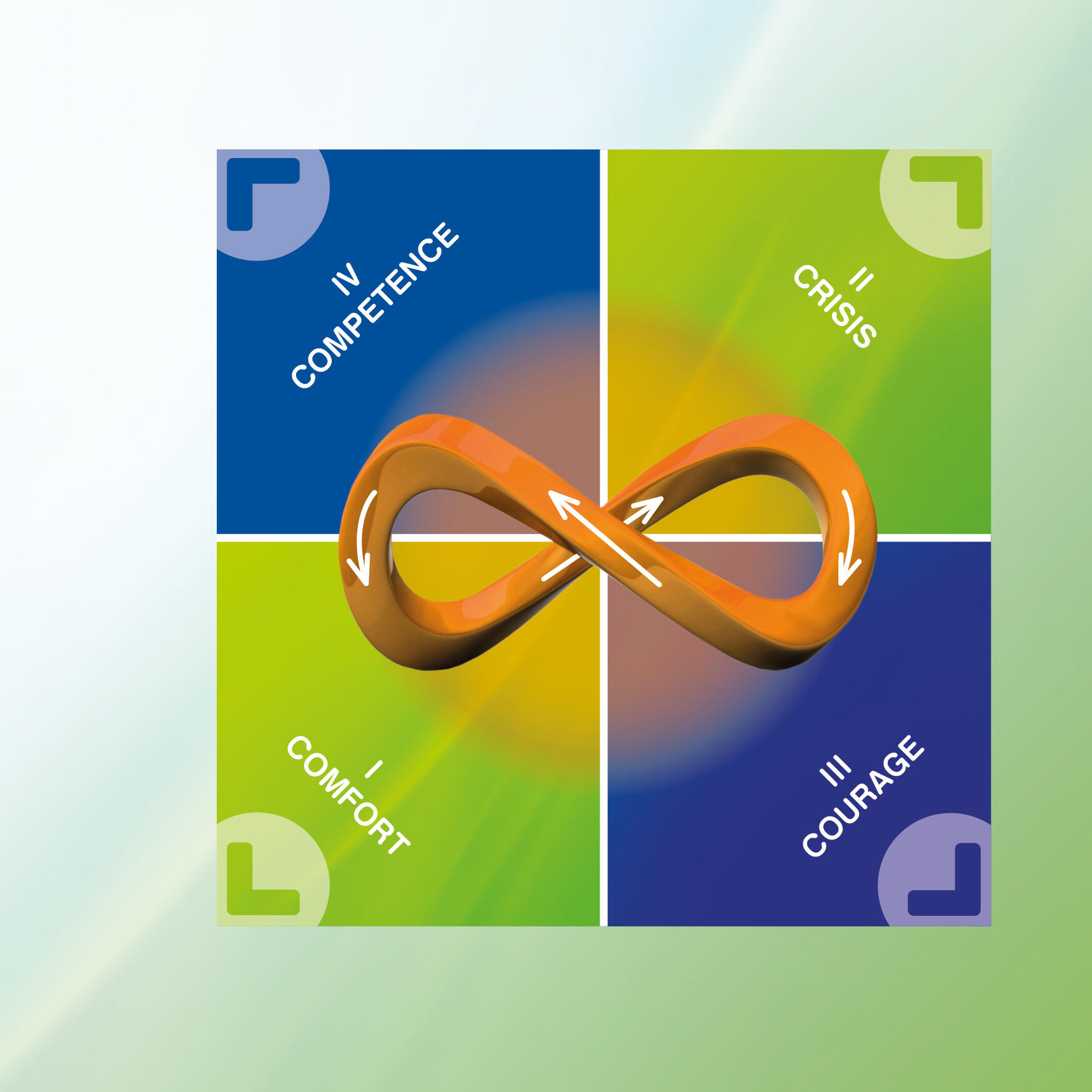
The Cycle of change
You may be here because something in your life feels out of sync. Perhaps circumstances around you are changing and you sense you need to adapt. Or maybe you have grown internally, by doing the inner work, and you feel you've outgrown the life you’re living.Either way, you’re noticing a discrepancy between where you are and where you want (or need) to be. There is nothing wrong with you, nor with the situation. It is life inviting you to evolve.Throughout the years I developed a practical model that explains transformation: the cycle of change. It is a simple, clear framework to help you understand the situation you are experiencing, without judgment. It reveals the underlying structure of human change so you can move through your experience with clarity and compassion.The Cycle of Change describes four natural states we move through again and again:
1. Comfort: When life feels familiar and in control
2. Crisis: When life feels out of control and unfamiliar
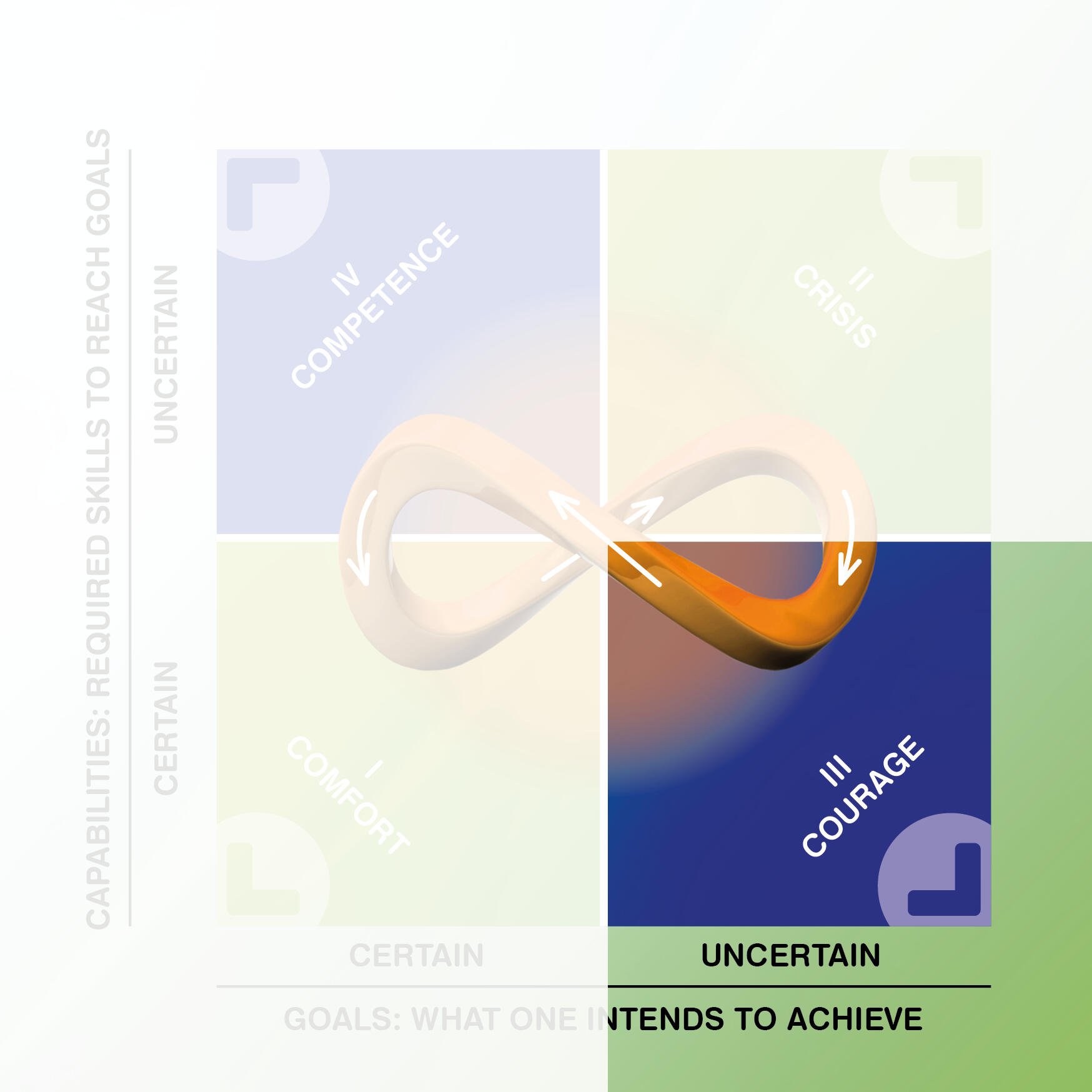
3. Courage: When you find the courage to explore other ways
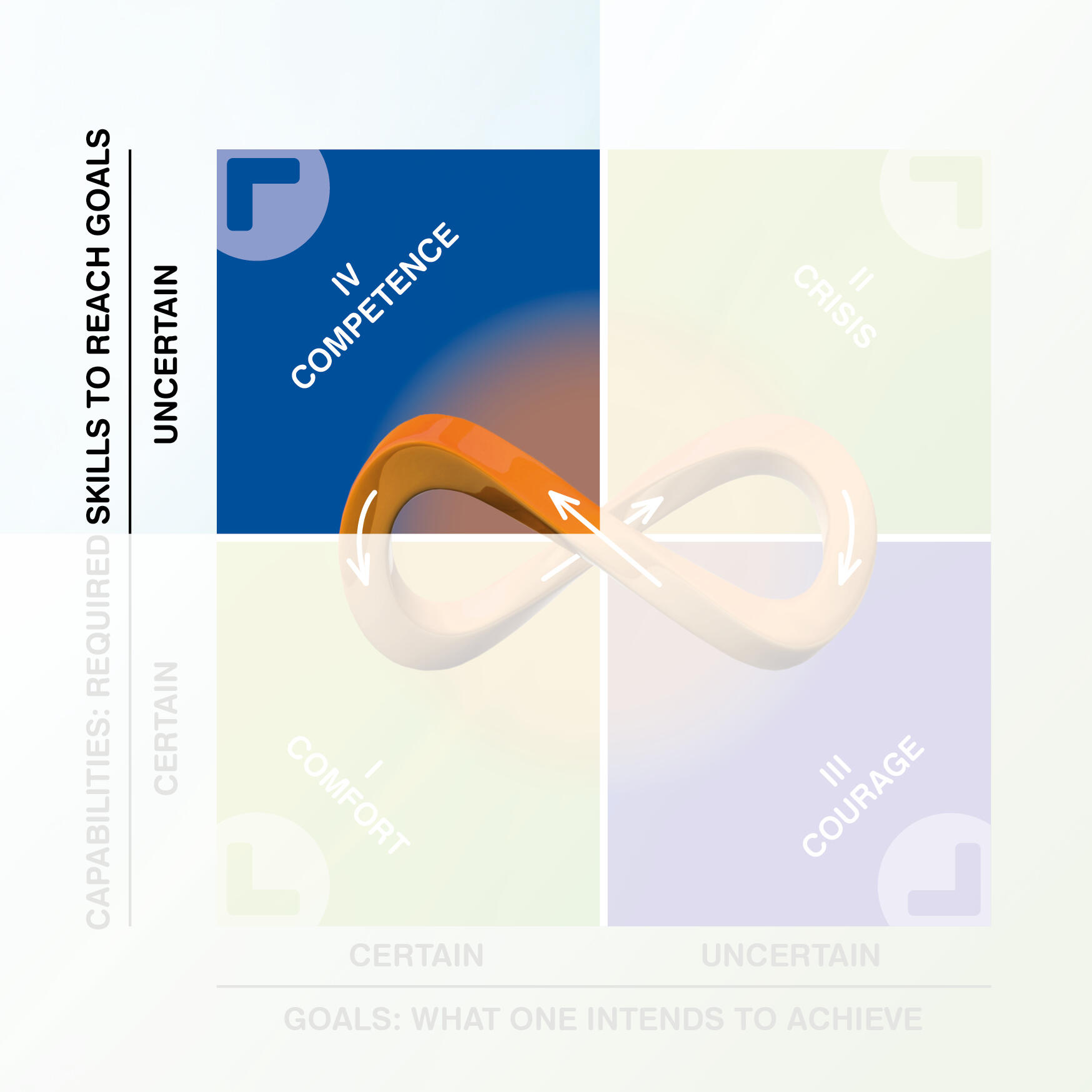
4. Competence: When new ways of being take rootSometimes life pushes us out of our comfort zone through external events (for instance because of loss, illness, or conflict). Sometimes it starts from the inside (healing, a deeper truth emerging). Either way, the same pattern appears.Step by step I will explain the model. I'll start with the 2 axes that define the 4 states.

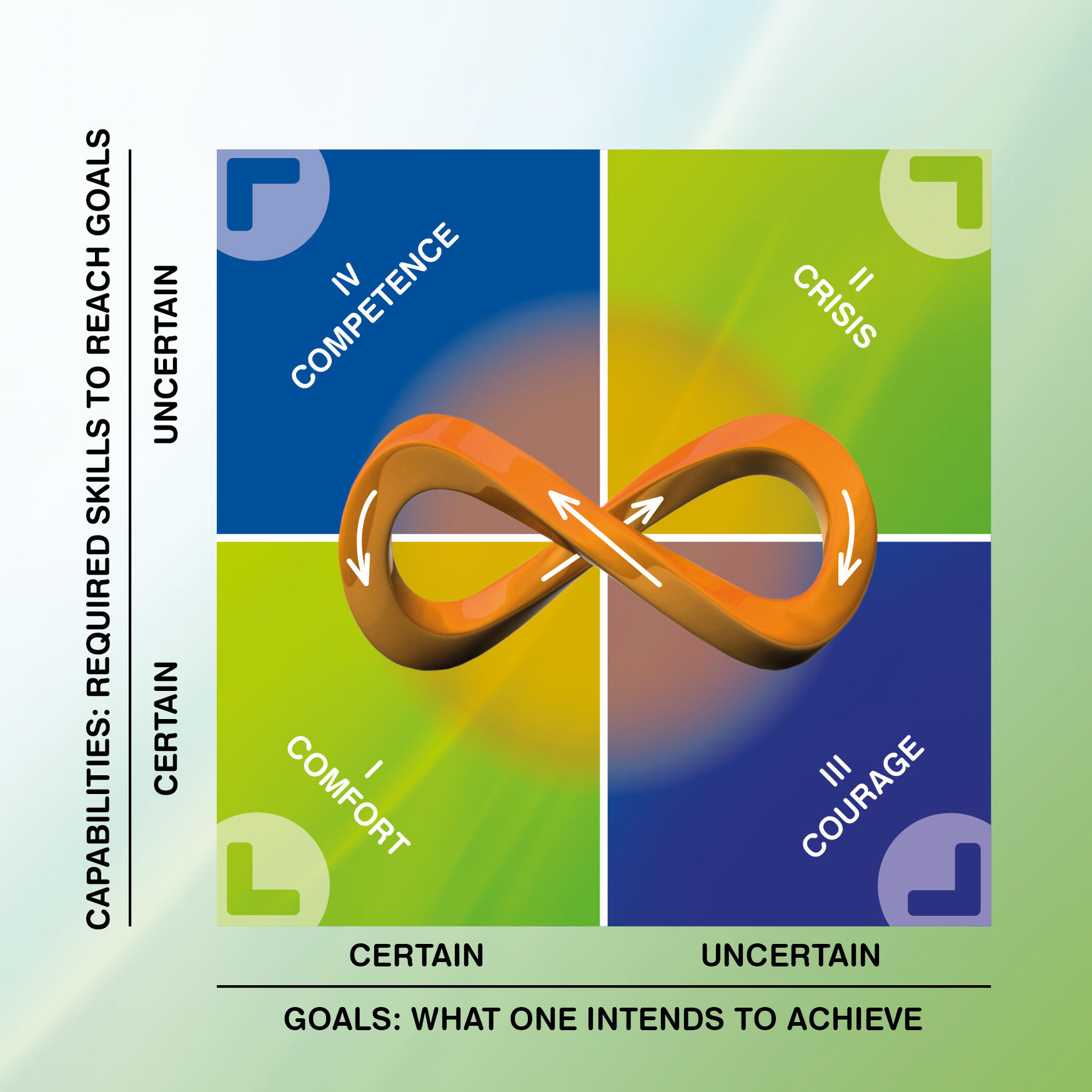
two dimensions
The Cycle of Change is built on two simple yet powerful dimensions: your goals and your capabilities.
Both of these can feel either certain or uncertain, depending on where you are in life.Two dimensions
1. Goals: This axis reflects how clear your direction feels.
2. Capabilities: This axis reflects how equipped you feel to meet what life brings.About Goals
When goals are certain, you know what you want, where you’re going, or what matters to you. When goals become uncertain, your sense of direction blurs. What used to feel meaningful may no longer fit, and the future feels undefined.About Capabilities
When capabilities feel certain, you trust your skills, strengths, and resources. However, when capabilities feel uncertain, you may feel unprepared, overwhelmed, or unable to respond the way you normally would.The degree of uncertainty
Both axes exist on a spectrum. You rarely feel 100% certain or 100% uncertain. But the more uncertainty you experience in both your goals and your capabilities, the more intense the inner experience becomes.At mild levels, you may feel stretched, restless, or confused.
At very high levels of uncertainty, when both your direction and your capacities feel unclear, the experience can feel overwhelming, as if the ground beneath your feet is disappearing.Four states
As these two axes intersect they create four states. The combinations form the four natural states of the Cycle of Change:
1. Comfort: Goals certain & Capabilities certain
2. Crisis: Goals uncertain & Capabilities uncertain
3. Courage: Goals emerging & Capabilities uncertain
4. Competence: Goals certain & Capabilities emergingEach of these four states represents a different inner experience of change. Let's go to the first state: Comfort.

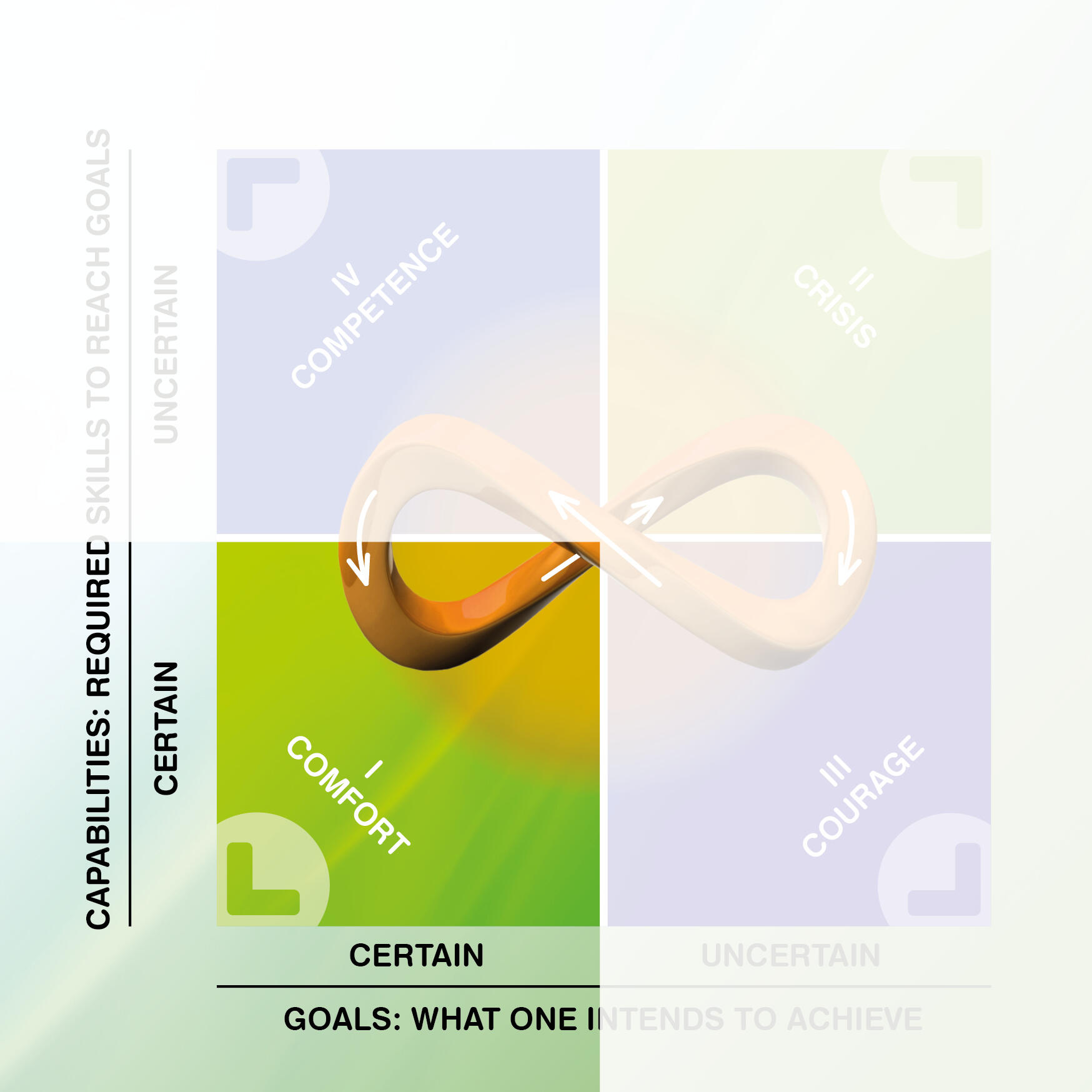
1. Comfort
In the state of Comfort, both your goals and your capabilities feel certain. You have a clear sense of what you’re doing, why you’re doing it, and how to handle most situations. Life feels familiar, stable, and predictable. Your routines, roles, and habits provide consistency and continuity, and things function in a way that feels manageable, sometimes even effortless.Comfort can feel like contentment: a place where you can rest, breathe, and settle. It offers grounding, containment, and a sense of being in control of your life.Yet even inside Comfort, subtle signs of change can begin to appear. A faint restlessness. A quiet sense of limitation. A whisper that something no longer fits as well as it used to. These small shifts are often the first signals that life, either internally or externally, is beginning to move.You might notice:
• Subtle boredom, restlessness, or lack of aliveness
• A feeling that you’ve stopped growing or expanding
• A quiet curiosity emerging, even if you’re not acting on it yetAs time passes, change becomes inevitable. Life evolves, circumstances develop, relationships change, and responsibilities grow. When the world around you moves in a new direction but your inner perception or way of responding does not adapt, the familiar terrain of Comfort begins to feel less and less comfortable. What once felt stable may start to feel tight, outdated, or misaligned. Tension appears. The gap between who you are now and the life you are living slowly widens.Sometimes this transition is slow-paced: a sense of discomfort, a pull toward something new. Other times the transition comes unexpectedly, and more intense. Whether it comes slow or fast, the transition is leading into the state of Crisis, where both your direction and your capabilities feel uncertain.Let's explore this next state: Crisis.

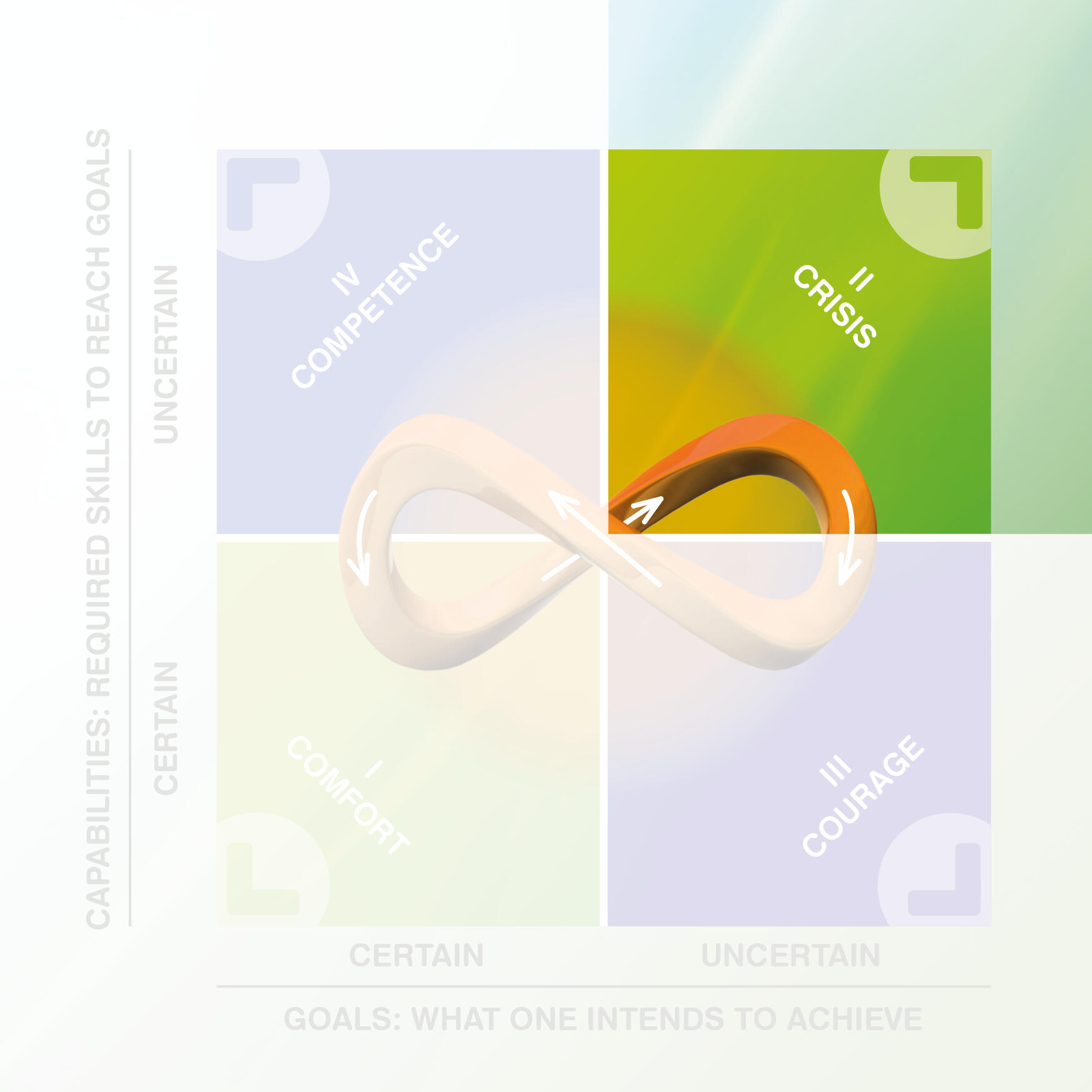
2. Crisis
In the state of Crisis, both your goals and your capabilities feel uncertain. The clarity you once had dissolves. What used to make sense no longer fits. A crisis is, above all, an inner experience — not an objective fact. What feels overwhelming to you might be manageable for someone else, and vice versa. It is the loss of orientation and stability that defines this state.A crisis can arrive unexpectedly and very rapidly — a piece of news, a sudden change, a shock. For example: you are fired or let go, your partner ends the relationship, a loved one dies, or your health shifts without warning. But crisis can also develop slowly and quietly. You may simply realise that who you are has outgrown the life you are living. Meaning fades, direction blurs, and something inside you collapses without anything dramatic happening on the outside.In Crisis, life feels chaotic or overwhelming. The ground beneath your feet seems to move. You may feel lost, anxious, stuck, or “between worlds,” as old ways of coping no longer work and new ones have not yet formed.Because this state is so uncomfortable, our natural reaction is to resist it. We label the situation as a problem, try to regain control, or attempt to push life back to how it used to be. But trying to control outer circumstances takes enormous energy — and often increases the tension. A more courageous movement is to turn inward and ask: Why is this affecting me so deeply? What in me experiences this as a crisis?When we dare to look inside, we often discover that the intensity of the moment touches something older. The body and nervous system remember experiences from childhood that were too overwhelming to process at the time. These memories were pushed away into a kind of inner Pandora’s box to keep us safe — but keeping the lid closed costs energy, creativity, and aliveness. Life invites us to open that box, not to harm us, but to free us. And opening it requires courage, which is one reason people often stay in old patterns: even dysfunction can feel familiar and therefore safe.Even though Crisis is painful, it plays a vital role. It exposes what no longer matches your growth and makes you aware of where your life has fallen out of alignment. Crisis disrupts outdated structures and clears the space for a more authentic next step — long before you know what that step will be.When your resistance softens, even just a little, a new possibility appears: the willingness to explore. The first spark of curiosity. This marks the beginning of the next state in the model: Courage.

3. Courage
Courage begins at the moment when the intensity of Crisis softens just enough for you to stop resisting what is happening. You are not yet clear, not yet confident, but something in you becomes willing. A small inner shift occurs: instead of fighting reality or trying to return to the past, you start turning toward what is here now. Courage does not mean the absence of fear; it means moving gently even while fear is still present.At this stage, your goals are only beginning to emerge. You do not yet know exactly where you are going — you simply sense that the old direction is no longer valid. This first willingness is subtle and often quiet. It may appear as a single question, a fresh perspective, or a moment of curiosity. Yet this tiny movement marks the beginning of transformation: a transition from holding on to letting go.Because nothing is fully formed yet, the state of Courage is a phase of exploration. You are stepping into the unknown, without clear reference points or guarantees. You experiment. You try something, observe, adjust, and try again. This is a period of trial and error, and it is important to remember that this is not failure but a natural part of learning. You discover what resonates and what doesn’t. This stage can feel unsteady or confusing, not because you are doing something wrong, but because you are navigating a reality that is genuinely new.It is completely normal to move back and forth between Courage and Crisis during this phase. Change rarely unfolds in a straight line. What matters is not perfection, but the willingness to return to exploration each time you drift back into old fears or patterns.As a new goal or direction begins to take shape, another realisation often follows: new capabilities are required to move toward it. You see that who you have been is not yet equipped to live the life that is calling you. This can be both inspiring and confronting. Courage therefore involves more than finding a new direction — it also requires the willingness to reinvent yourself. You gradually unidentify from an older identity and begin to step into a more authentic one. This inner reshaping makes this phase challenging; transformation is not only conceptual but embodied.Because of this vulnerability and uncertainty, the pull of the past can still be strong. Part of you may want to return to what is familiar, even if it no longer fits. This backward movement is natural, but Courage invites something different: a gentle commitment to keep moving forward, even without certainty and even without solid ground under your feet.You might notice:
• A growing curiosity about what could come next
• The courage to take small steps without knowing the outcome
• A willingness to ask for help or explore new options
• Breakthroughs mixed with insecurity or doubt
• The first sense of possibility returningTo stay in Courage requires time, patience, determination, trust, and surrender. Patience, because change unfolds at its own pace. Determination, because old patterns pull strongly. Trust, because the outcome is still unknown. And surrender, because you cannot control the timing or shape of what emerges.As you continue exploring, experimenting, failing, learning, and adjusting, something begins to take shape within you. Your direction becomes clearer, and with that clarity you also begin to see the capabilities required to move toward your new goals. You start taking steps in that direction — sometimes small, sometimes hesitant — and each one strengthens your alignment with what is emerging.Slowly, the uncertainty that defined Courage gives way to a growing inner confidence — a sense that you are no longer merely searching, but beginning to follow a path that feels increasingly true.This strengthening marks the transition into the next state: Competence — where new ways of being begin to take root and become embodied.

4. Competence
Competence is the state in which the direction that emerged in Courage becomes clearer and begins to stabilise. You now have a sense of where you are going, and your capabilities — though still developing — are growing to meet that direction. What once felt unfamiliar starts becoming natural. What once required effort begins to feel more embodied.In this state, you are learning to live from a new way of being. You practise different behaviours, cultivate new perspectives, and strengthen the emotional and practical skills needed to move toward your goals. The uncertainties of Courage give way to a more grounded sense of “I can do this.” It doesn’t mean everything is easy or complete — but you are no longer wandering. You are applying, integrating, and growing.At the same time, this phase can also feel challenging and frustrating. Competence requires you to unlearn old ways of thinking, responding, and behaving, while simultaneously learning entirely new ones. This process naturally involves trial and error — many attempts, many adjustments, moments of progress followed by setbacks. It is not a sign that something is wrong; it is simply the reality of integrating change.For some people, this might mean learning new communication skills, practising boundaries, or building emotional regulation. For others, it may involve professional growth — taking a course, changing roles, or developing entirely new competencies. Whatever the context, Competence requires repetition, experimentation, and patience.New capabilities do not develop overnight. They need time, repetition, and practice. Sometimes this phase even requires formal education, specialised training, or long-term development to build the skills your new direction demands. Competence is not just an inner shift; it is the steady work of embodying a new way of living. Although demanding, each effort strengthens your alignment with who you are becoming.Competence often feels energising. You start seeing progress, noticing results, and experiencing the first signs of alignment between your inner world and your outer life. New habits begin to form. New responses become available. Where you once fell back into old patterns, you now pause, choose differently, and move forward with more clarity and intention.You might notice:
• A clearer sense of direction and purpose
• Growing confidence in your abilities
• New habits forming naturally over time
• More stable emotional responses
• A sense of alignment between who you are and what you do
• Increasing trust in yourself and in lifeYet even in Competence, the pull of older patterns can occasionally return. This is natural. Growth is not linear, and moments of doubt or regression simply show where integration is still unfolding. The key is not to interpret these moments as failures, but as part of the rhythm of learning. Competence strengthens through practice, consistency, patience, and compassion toward yourself.As your new skills deepen and your identity solidifies around a more authentic way of being, life begins to feel more stable and congruent again. You’re not back in the old Comfort — you’ve arrived at a new Comfort, one that reflects who you have become rather than who you once were.This completes the cycle: from Comfort, through Crisis, into Courage, and into Competence — eventually arriving at a higher, more authentic level of Comfort. From here, life will continue to evolve, and the cycle will naturally repeat itself whenever your next chapter of growth begins.

Contact
I deliberately don’t use social media. If you want to reach me the easiest way is via the contact form below. Share a few lines about what is happening in your life. You do not need to explain everything. Just enough for me to understand where you are, and what kind of support you sense you need.

Thank you
Thank you for reaching out. I have received your message. I will respond to you when I have read it with full attention.
